RSS

New property listed in Zone 12, Edmonton

I have listed a new property at 9910 115 Street NW in Edmonton. See details here

Build your dream home on one of Edmonton's most prominent river valley lots. Perched at the top of the bank in Oliver, this 7,043 sq ft west-facing lot offers breathtaking panoramic views south and west over Victoria Golf Course, the North Saskatchewan River and the river valley. Watch the sun rise in the east, pour in all day and set in the west, with views most never knew were available to the public. Held by the same family for over five decades, this property has NEVER been on MLS, and lots like this simply don't come up for sale. Minutes to downtown, the Ice District, MacEwan, the U of A and river valley trails, on a quiet, tree-lined street. Rebuild here and become part of the history of this iconic block. For developers, 9910 sits beside an RA9 high-rise zoned parcel and is a key piece of a potential 29,145 sq ft, 3-lot assembly. Lot sold separately. Value is in the land; the home is sold as is, where is. A once-in-a-lifetime opportunity on the river valley.

Read

New property listed in Zone 17, Edmonton

I have listed a new property at 7733 81 Avenue NW in Edmonton. See details here

Welcome to the sophisticated “Luxor” by Royal Developments in desirable King Edward Park! This modern 2-storey 4 bed/3.1 bath 1582 sqft half duplex features a striking exterior with Lux panels, acrylic stucco and black-paned windows. Inside, enjoy 9’ ceilings on all 3 levels, 8’ doors, engineered hardwood and tile flooring. The open main floor offers a tiled feature wall with 60” electric fireplace and a stunning kitchen with 10’ island, two-tone cabinetry, quartz countertops and stainless steel appliances. Upstairs features 3 bedrooms, including a spacious primary with walk-in closet and ensuite. The fully finished basement with separate entrance provides additional living space. A custom deck and heated double detached garage complete this beautifully designed home in a fantastic central location!

Read

Open House. Open House on Saturday, October 24, 2026 12:00PM - 2:00PM

Please visit our Open House at 54 KINGSBURY Circle in Spruce Grove. See details here

Open House on Saturday, October 24, 2026 12:00PM - 2:00PM

Welcome to this beautifully designed 2-storey home with a front-attached garage, offering the perfect blend of style, comfort, and functionality! The bright, open-concept main floor features soaring ceilings, expansive windows, and a spacious living and dining area that flows seamlessly into the modern kitchen, complete with a large centre island and convenient walk-through pantry. Upstairs, you'll find 3 generously sized bedrooms, including the primary suite with double-door entry, a spacious walk-in closet, and a luxurious ensuite featuring a freestanding soaker tub and dual vanities. A versatile bonus room with vaulted ceilings provides the perfect space for relaxing or entertaining. Step outside to enjoy the private backyard with beautiful views, featuring a concrete pad in the backyard and additional concrete extending along the side of the home. A fantastic opportunity to enjoy modern living with thoughtful features throughout!

Read

7 Lease Renewal Mistakes Edmonton Landlords Make

A lease renewal looks like the easy part of owning a commercial property. The tenant is already there, the space works for them, and nobody has to market anything. That’s exactly why renewals go wrong. They get left too late, priced from habit and signed in a hurry.

Here are the seven mistakes we see most often from Edmonton landlords, and what to do instead.

1. Waiting for the Tenant to Bring It Up

By the time a tenant raises its renewal, it has usually already toured other spaces and knows what it wants to pay. You’re negotiating on its timeline.

Do this instead: read the renewal clause well before the notice window opens. Many leases require the tenant to give written notice within a set window, such as 6 to 12 months before expiry. Put the window and the expiry date in your calendar, and start the conversation first, ideally 12 to 18 months ahead for larger spaces.

2. Setting Renewal Rent From the Old Rent

“Last year’s rent plus a bit” is the most common way to price a renewal, and often the wrong one. Edmonton’s market has moved unevenly:

  • Industrial vacancy was 2.7% in Q2 2026, and rents are up 3.5% since the end of 2025 (CBRE). Many industrial landlords who renew at old rates are leaving money on the table.

  • Downtown office vacancy was 20.7% (CBRE, Q2 2026). Older office buildings may need to offer something to keep good tenants.

  • Retail vacancy was 5.6% citywide (CBRE, 2026). Busy neighbourhood centres can hold firm, while weaker centres have less room.

Do this instead: price the renewal from recent lease deals for similar space nearby, net of the incentives in those deals. If the lease says “market rent,” you’ll need that evidence anyway, especially if it ever goes to arbitration.

3. Comparing Headline Rents

A new tenant offering a higher rent can look like a win. Once you count the cost of getting that tenant in, it often isn’t.

Do this instead: compare net effective rent, the rent you actually earn each year after free rent, improvement allowances and vacancy are spread over the term. Here’s an illustrative example for a 2,000 sq. ft. retail unit on a five-year term. The numbers are made up to show the method.

Renew current tenantNew tenant
Net rent$26.00 per sq. ft.$28.00 per sq. ft.
Free rentNone3 months
Improvement allowance$3 per sq. ft. touch-up$25 per sq. ft.
VacancyNone5 months, carrying $16 per sq. ft. of taxes and operating costs
Net effective rent$25.40 per sq. ft.$20.27 per sq. ft.

The new tenant offers $2 more per square foot. Once you count the free rent, the build-out and five months of an empty unit, you earn about $5 less per square foot every year, before leasing fees.

4. Going Into the Renewal With Messy Operating Costs

Tenants often use a renewal to push back on additional rent: their share of property taxes, insurance and common area costs. If your year-end reconciliations have been late, unclear or surprising, expect the tenant to ask for audit rights, caps on increases or a lower share.

Do this instead: send clean, on-time reconciliations in the year before the renewal, with backup for any big changes. Edmonton’s 2026 non-residential tax rate is about $29,266 per $1 million of assessed value, so property tax is often the biggest line. If you think your assessment is too high, look at it before you go into the renewal.

5. Losing the Guarantee

If an individual personally guaranteed the original lease, that guarantee is part of what the lease is worth to you. A guarantor’s liability can end if the lease is changed without the guarantor’s consent.

Do this instead: have the guarantor sign the renewal or extension too. If you’re asking for a new personal guarantee, remember that under Alberta’s Guarantees Acknowledgment Act, an individual’s guarantee generally needs a lawyer’s certificate to be enforceable.

6. Not Checking Who the Tenant Is Now

A tenant that signed five years ago may not be the same business today. It may have new owners, a new line of business or weaker finances.

Do this instead:

  • Check finances again. Ask for current financial statements, as you would for a new tenant.

  • Ask about ownership. Find out whether the business has been sold or restructured. Many leases treat a change of control as an assignment that needs your consent.

  • Check any new use. If the tenant wants to change how it uses the space, confirm the new use is allowed under the zoning. Some uses, like liquor and cannabis stores, have separation distance rules.

7. Letting the Lease Expire Unsigned

When the end date passes and the paperwork isn’t done, the tenant usually stays on under the holdover clause. That’s often month to month, sometimes at a higher rent. Either side can then walk away on short notice, which isn’t a good position for a landlord.

Do this instead: agree on terms and have your lawyer prepare the renewal or extension a few months before expiry. If the lease is being extended past three years, ask whether the registration or the tenant’s caveat on title needs updating.

Why Renewals Matter When You Sell

Buyers and lenders look closely at how much lease term is left. A building with strong tenants on long renewals is easier to finance and usually sells for more. One with several leases ending in the same year makes buyers nervous. If you’re thinking of selling in the next few years, plan your renewals now. See our office, retail and industrial property pages, or our industrial investment property page.

Leasing industrial space yourself? Read our tenant guide: Your Industrial Lease Is Up: Should You Renew, Move or Buy?

Frequently Asked Questions

When should a landlord start lease renewal talks?
Start before the tenant’s notice window opens. For larger spaces, 12 to 18 months before expiry gives both sides time to compare options and agree on terms.

Can a landlord refuse to renew a commercial lease in Alberta?
Generally yes, unless the lease gives the tenant a renewal option. Alberta has no commercial tenancy statute and no automatic right to renew. If the lease has an option and the tenant exercises it properly, the landlord is usually bound by its terms.

Is there a limit on rent increases when renewing a commercial lease in Alberta?
No law caps commercial rent increases in Alberta. Renewal rent is set by the lease, which may fix it in advance or set it at market rent, or by negotiation.

Is it better to renew a tenant or find a new one?
Compare net effective rent. Once you count free rent, improvement allowances and months of vacancy, keeping a good tenant at slightly lower rent often earns more than leasing to a new tenant at a higher headline rent.

Do I need a lawyer for a commercial lease renewal?
It’s a good idea. A lawyer can prepare the right document, either a renewal or an extension, keep any guarantee in place, and handle registration on title.

Need help with a renewal or a vacancy? Contact our team.

Read

Your Industrial Lease Is Up. Should You Renew, Move, or Buy?

Nobody wakes up wondering whether to buy a warehouse. The question arrives in an envelope, usually nine to twelve months before your term expires, with a number in it that’s higher than you were expecting.

That’s when business owners start running the math. Here’s how to run it properly — and what the comparison looks like in Edmonton right now.

First: understand the position you’re negotiating from

Edmonton’s industrial market is tight and has been for a while. CBRE put vacancy at 2.7% in the second quarter of 2026 — under 3% for seven consecutive quarters — with availability at 4.5%, a decade low. Rents climbed 3.5% over the first half of the year and another 3.3% in Q3.

The demand is concentrated exactly where most owner-operators shop. Deals of 25,000 square feet or less accounted for 91.2% of Edmonton industrial transactions in Q2 2026.

What that means for your renewal: your landlord knows the market is thin, and knows that moving costs you money and downtime. You have less leverage than you would in a soft market.

It also means something about the alternative. Average asking sale prices are up 7.3% year over year — so buying isn’t cheap either, and the building you want won’t sit around.

Know what you’re actually paying now

Before comparing anything, get your true number. Industrial rent in Edmonton quotes in two pieces, and owners routinely underestimate the second one.

Net rent goes to the landlord. Additional rent is your share of property tax, building insurance and common maintenance — and it moves every year without anyone negotiating it.

Cushman & Wakefield’s Q2 2026 regional averages:

AreaNetAdditionalGross
Edmonton region$11.72$4.99$16.71
Northwest / Central$10.13$5.04$15.17
Northeast$10.01$6.00$16.01
Southeast$10.03$5.39$15.42
Sherwood Park$10.76$4.77$15.53
Leduc / Nisku$13.10$3.76$16.86
Acheson$16.30$4.95$21.25

Per square foot per year.

Two things to notice. Acheson is in a different league — roughly 40% above the regional gross. And additional rent varies more than people expect, from $3.76 in Nisku to $6.00 in the northeast. A lower net rent with high additional rent can cost more than the reverse.

Smaller bays also price higher per foot. The clearest size breakdown available is Avison Young’s from 2024: sub-5,000 sq ft units asked $12.00–$12.50 net against $8.25–$9.00 for space over 100,000. Dated, but the shape of it still holds.

Add 5% GST to all of it. Recoverable if you’re registered, but it’s cash flow in the meantime.

The three options, honestly

Option 1: Renew where you are

Cheapest in the short run and by far the least disruptive. No moving costs, no downtime, no rebuilding your power or your racking.

What to push on before you sign:

  • A renewal option for the next term, with the rate set by a defined mechanism rather than “market.” Alberta has no commercial tenancy legislation comparable to Ontario’s or BC’s — your rights come from the lease document and essentially nowhere else. If your current lease has no renewal right, you had no legal claim to be here at all after the term ended.

  • The escalation schedule. Annual steps compound. A 3% annual bump over a ten-year term means you finish paying 30% more than you started.

  • Your personal guarantee. In Alberta a guarantee isn’t enforceable unless a lawyer has gone through it with you and signed a certificate under the Guarantees Acknowledgment Act. If you’re re-signing, this is the moment to ask whether it still needs to be there — after five or ten years of clean payment history, you have an argument.

Have a lawyer read the entire document, not just the page with the new number on it.

Option 2: Move to a different leased space

Only worth it if the space itself is wrong — too small, wrong door height, wrong power, wrong location for your drivers.

Budget realistically for the switch: tenant improvements beyond whatever allowance you negotiate, moving, downtime, new signage, updating every address you’ve ever given a customer. For most small operations that’s a five-figure number before the first month’s rent.

In a 2.7% vacancy market, also budget time. The right bay may not exist this quarter.

Option 3: Buy

This is where the renewal letter sends a lot of owners, and sometimes correctly.

CBRE had Edmonton industrial averaging $181 per square foot at the end of 2025. Owner-users — businesses buying for their own operations — pay more, because they want smaller and newer: Cresa pegged owner-user pricing near $196 per square foot in mid-2025, and it’s risen since.

Condo bays have become the standard route for small businesses. Cresa reported condos made up the majority of Edmonton industrial sales in 2025, with owner-users accounting for 44 of 62 properties sold through that point in the year.

Financing, realistically:

  • BDC will finance up to 100% of project cost for a business buying its own premises, amortized up to 25 years, with interest-only available for the first 36 months. You’ll need at least 24 months of revenue history.

  • The Canada Small Business Financing Program covers up to $1,000,000 for purchasing or improving real property, arranged through your bank.

  • Conventional lenders typically want 25–35% down and underwrite your business’s ability to service the debt.

Closing costs people forget: appraisal ($3,000–$10,000+), Phase I environmental assessment ($3,000–$8,000+), legal ($3,000–$10,000+), and Land Titles at $50 plus $5 per $5,000 of value on both the transfer and the mortgage. On a $1M purchase with a $750K mortgage that’s $1,050 and $800 respectively. GST is usually self-assessed and recovered by a registered buyer rather than paid at closing — confirm with your accountant.

The comparison, run two ways

A 5,000 sq ft bay. Lease at the regional average. Purchase at $205 per square foot — above the $181 average and the $196 owner-user figure, because small newer condo bays are the expensive end of the market and that’s what you’d actually be buying.

Purchase price $1,025,000, 25% down, $768,750 borrowed at 6% over 25 years. That’s about $59,440 a year in payments.

Scenario A — operating costs match additional rent:

LeaseBuy
Cash at the start~$13,900 deposit$256,250 down + ~$12,000 closing
Annual rent / mortgage$58,600$59,440
Tax, insurance, maintenance$24,950$24,950
Annual total~$83,550~$84,390
Equity built, year 1$0~$13,700

Scenario B — property tax assessed at purchase price:

Edmonton’s non-residential rate would put tax alone near $30,000 on a $1,025,000 assessment. Add insurance and maintenance and the owner’s operating costs run closer to $42,000.

LeaseBuy
Annual total~$83,550~$101,440

Scenario B is the more likely one for a recent purchase, because assessments tend to follow transaction prices. That’s roughly $18,000 a year more in cash — against about $13,700 of equity in year one, rising annually.

So the honest summary isn’t “it’s a wash.” It’s: owning likely costs more in cash and converts some of that cost into equity. Whether that trade is good depends entirely on your time horizon.

The part the cost tables leave out

Tax treatment changes the comparison. Rent is fully deductible against business income. On the ownership side, mortgage interest is deductible but principal isn’t — though you can claim capital cost allowance on the building portion. Net effect varies enormously by business structure and income. This is a conversation with your accountant, not a blog post, but it can swing the comparison by thousands a year in either direction.

Owning has an exit cost. When you eventually sell: commission, mortgage discharge, legal, and potentially recapture of CCA you claimed plus capital gains on appreciation. Leasing ends when the term ends.

Owning has a repair bill. The roof, the overhead doors, the parking surface, the HVAC. As a tenant, most of that is a phone call. As an owner it’s a cheque.

The short version

Renew if the space works and you can negotiate the escalations down. It’s the cheapest answer and the one most owners should take.

Move only if the building itself is the problem.

Buy if you’re confident about ten-plus years in this location, you’re about to spend serious money on the space anyway — cranes, three-phase power, wash bay, fenced and graded yard — or you want the building as part of your retirement.

The clearest signal: if you’re about to spend $150,000 improving a building you don’t own, that’s the conversation to have before you sign the renewal, not after.

Questions we get asked

How much notice do I have to give my landlord?
Whatever your lease says. There’s no statutory default in Alberta. Find the clause now — many require six to twelve months, and missing it can auto-renew you into another full term.

Can my landlord just refuse to renew?
Yes, unless your lease grants you a renewal option. This surprises people every year.

What does additional rent actually cover?
Typically property tax, building insurance and common area maintenance, allocated by your share of the building. Ask for the reconciliation — you’re entitled to see how it was calculated if your lease says so, and you should check that your lease says so.

Is now a bad time to buy?
Asking prices are up 7.3% year over year and inventory is thin, so you’re not buying a dip. But rents are rising too, and a fixed mortgage payment against a rising rent curve is the actual argument for ownership — not the current price.

How much do I need down?
25–35% conventionally. Less through BDC or the Canada Small Business Financing Program if you qualify.


Want help running your own numbers? Send us your current gross rent, your square footage and your renewal date and we’ll tell you where you sit against the market — and whether this is a renewal conversation or a buying one.

General information only. Not financial, legal or tax advice. Confirm with your accountant, lender and lawyer before acting.


Read

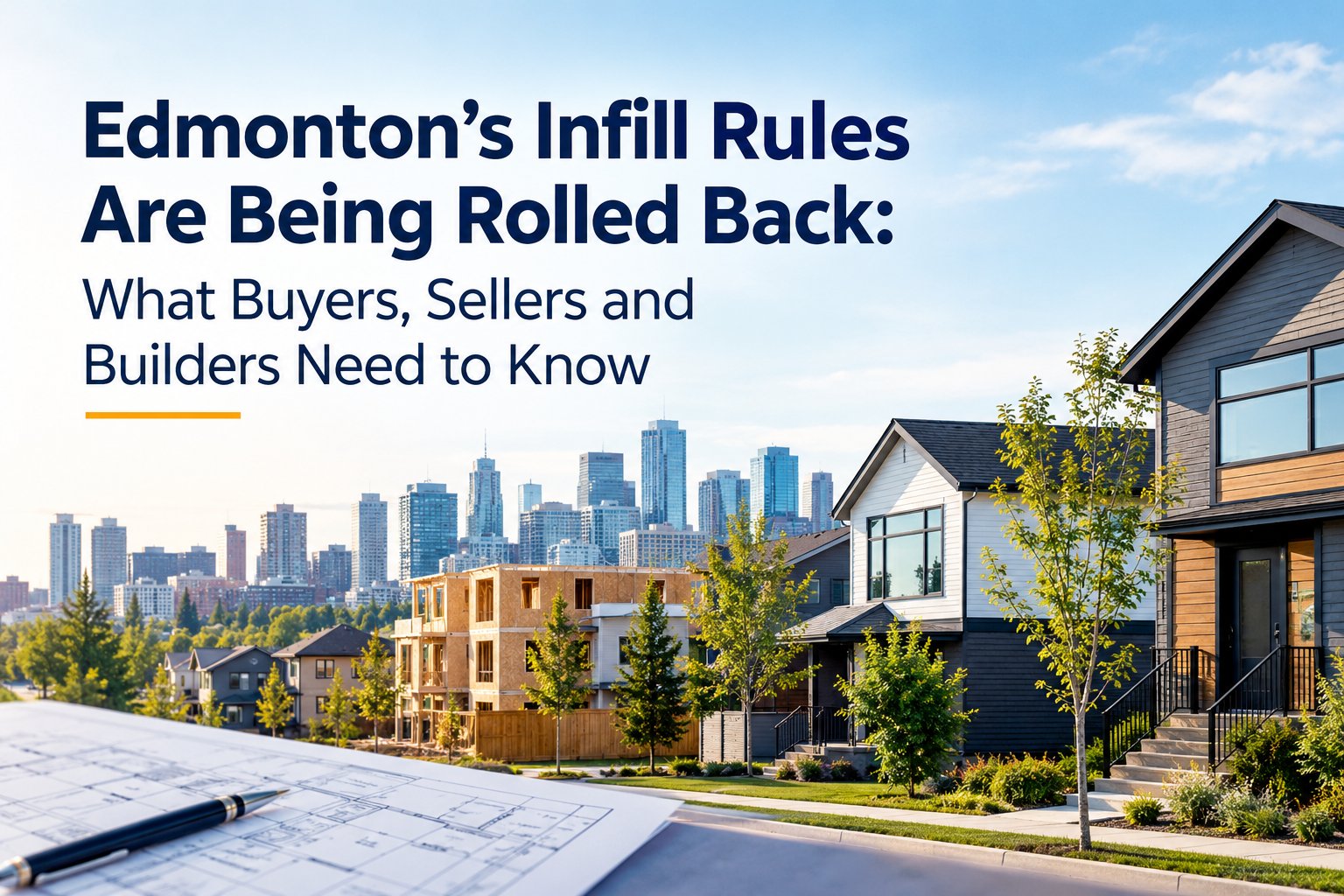
What Edmonton’s Infill Rollback Means If You Already Own a Home

Most of the coverage of Alberta’s order to Edmonton has been written for developers. Permit timelines, unit counts, pro formas.

That leaves out almost everyone. The majority of people affected by this aren’t building anything — they own a house on a street where someone else might, and they want to know one thing: does this change anything for me?

Here’s that version.

The short answer

If your home is built and you’re staying put, nothing about your property changes. No rezoning happens to you. Your title, your taxes, your house — untouched.

What changes is the range of what can be built near you, and for some owners, what a builder would pay for your lot. Whether that matters depends entirely on which of the three situations below you’re in.

What actually happened

On October 8, 2026, the Alberta government directed Edmonton to undo the zoning changes that took effect at the start of 2024 and to reinstate the on-site parking minimums the city dropped in 2020.

Edmonton has three months to make the change — a deadline that lands in early January 2027 — followed by an 18-month period to consult and write replacement rules. The rolled-back rules apply throughout that review.

Two details matter more than the headline:

Approved projects are safe. The province confirmed on October 16 that infill already permitted can proceed as planned.

The city hasn’t received the written directive yet. At a special council meeting on October 16, administration said it was still working from the announcement alone. Until that document arrives, the precise scope is an open question — including whether the rollback touches only residential infill or reaches other parts of Zoning Bylaw 20001.

So: direction is clear, details aren’t.

Why Edmonton’s rules looked the way they did

A brief version, because the sequence explains a lot of the confusion.

Edmonton eliminated citywide parking minimums in July 2020, among the first large Canadian cities to do it. In October 2023 council adopted Zoning Bylaw 20001, folding most residential categories into a single Small Scale Residential zone, and it came into force January 1, 2024. On many RS lots, that permitted up to eight dwellings with no rezoning — the origin of the five- to eight-unit buildings that have appeared across mature neighbourhoods.

Council kept adjusting after that. In June 2025 it shortened permitted building length mid-block and added façade requirements. It debated dropping the eight-unit ceiling to six twice across late 2025 and early 2026 and declined both times, the last by a vote of 8 to 4. In April 2026 it lowered the maximum RS height from 10.5 metres to 9.5, effective for permits approved from August 1.

The volume this produced is the reason the province gave for stepping in. Taproot Edmonton counts 5,187 homes permitted in five- to eight-unit buildings in mature neighbourhoods since the bylaw took effect — roughly 13% of everything permitted in that window.

Premier Danielle Smith characterised the resulting development as irresponsible. Municipal Affairs Minister Dan Williams cited neighbourhood fit, parking pressure and property values, and framed the order as a conversation rather than a final word. Mayor Andrew Knack called it uninformed and argued it will worsen affordability. Alberta Municipalities objected as well. Council has said it will examine its legal options without committing to a challenge.

Which of these three are you?

1. You own a home and you’re staying

Nothing to do. Your property isn’t being rezoned and your existing house is unaffected either way.

The practical change is what might appear across the street. If a project near you already holds its permit, it proceeds regardless of the rollback. For anything not yet approved, the city’s standard notification and appeal process still runs — and you can check the status of any address yourself at maps.edmonton.ca rather than relying on rumour.

One thing worth watching: if parking minimums return, newer projects near you will carry more on-site stalls than the ones built in the last two years. That’s a street-level difference you’ll notice before you notice anything else.

2. You own an older home on a big lot, a corner, or near a main road

This is the group with something real at stake.

Over the past two years, some mature-neighbourhood lots sold above what a single-family buyer would pay, because a builder could put several units on them. If the permitted unit count drops and parking becomes mandatory, that arithmetic changes — and so, potentially, does what a builder will offer.

Important caveat: land value isn’t only about unit count. Location, lot dimensions, frontage, the condition of the existing house and whether it’s worth keeping all still drive price. Some lots were never redevelopment candidates and won’t move at all.

If selling to a builder was part of your plan for the next year or two, get a read on your lot’s position before the rules settle rather than after. What comparable lots have actually transacted at is a more useful number right now than any forecast.

3. You’re buying a newly built infill home

Already built, or already approved? You’re fine. The province has been explicit about that.

Two questions to put to the builder before you commit:

Has the development permit been approved? If construction hasn’t begun, this is the question that determines whether the project happens as advertised. Make your offer conditional on a satisfactory answer in writing.

What parking comes with the unit? Plenty of recent infill was built with minimal or no on-site parking, entirely legally. That doesn’t become a defect — but once newer projects are required to include parking, buyers will be comparing the two. It’s a resale consideration worth pricing in now.

What nobody can tell you yet

Being straight about the gaps:

  • The written directive hasn’t been issued. Everything about scope is provisional until it is.

  • Pending applications are in limbo. Approved means safe. Submitted-but-undecided is unresolved.

  • Whether council litigates is unknown. It’s been raised, not decided.

  • The landscape securities council had already scheduled for January 1, 2027 sit awkwardly against the rollback, and how they interact isn’t clear.

Anyone offering you certainty on these points this week is guessing.

The bottom line

Built homes and approved projects are untouched. The uncertainty sits almost entirely with land that hasn’t been developed yet and projects that haven’t been permitted yet.

If you’re an owner with no plans to sell, this is news to follow, not news to act on. If you’re sitting on a lot a builder has expressed interest in, the next ninety days are the window where knowing your position is worth something.

Want to know where your property sits in all this? Get in touch and we’ll tell you honestly — including if the answer is that it doesn’t affect you.

Common questions

My house is already built. Am I affected?
No. The rollback concerns what can be built going forward. Existing homes keep their legal status regardless of the rules under which they were approved.

Can the project going up next door be stopped?
If it holds an approved development permit, no — the province confirmed approved projects continue. If it hasn’t been approved, the city’s usual notice and appeal process applies.

I was planning to sell to a builder next spring. Should I move faster?
Possibly, but not reflexively. The honest answer depends on whether your lot was attractive because of unit count or because of location and size. Those are different situations with different answers. Find out which one you’re in before you decide.

Will my property value drop?
There’s no evidence either way yet, and anyone claiming otherwise is speculating. The province’s stated rationale includes protecting property values. Owners whose lots carried a redevelopment premium may see that premium soften. Most owners won’t see a direct effect at all.

Is parking coming back for sure?
That’s the province’s order: restore the minimums that applied before July 2020. The specifics will depend on the written directive.

When does any of this take effect?
Edmonton has until early January 2027 to comply. The rules themselves depend on a directive the city had not received as of October 16.

This post will be updated as the province’s written directive is released. Last reviewed October 17, 2026.

Read

Open House. Open House on Sunday, October 18, 2026 12:00PM - 2:00PM

Please visit our Open House at 54 KINGSBURY Circle in Spruce Grove. See details here

Open House on Sunday, October 18, 2026 12:00PM - 2:00PM

Welcome to this beautifully designed 2-storey home with a front-attached garage, offering the perfect blend of style, comfort, and functionality! The bright, open-concept main floor features soaring ceilings, expansive windows, and a spacious living and dining area that flows seamlessly into the modern kitchen, complete with a large centre island and convenient walk-through pantry. Upstairs, you'll find 3 generously sized bedrooms, including the primary suite with double-door entry, a spacious walk-in closet, and a luxurious ensuite featuring a freestanding soaker tub and dual vanities. A versatile bonus room with vaulted ceilings provides the perfect space for relaxing or entertaining. Step outside to enjoy the private backyard with beautiful views, featuring a concrete pad in the backyard and additional concrete extending along the side of the home. A fantastic opportunity to enjoy modern living with thoughtful features throughout!

Read

New property listed in Spruce Grove, Spruce Grove

I have listed a new property at 54 KINGSBURY Circle in Spruce Grove. See details here

Welcome to this beautifully designed 2-storey home with a front-attached garage, offering the perfect blend of style, comfort, and functionality! The bright, open-concept main floor features soaring ceilings, expansive windows, and a spacious living and dining area that flows seamlessly into the modern kitchen, complete with a large centre island and convenient walk-through pantry. Upstairs, you'll find 3 generously sized bedrooms, including the primary suite with double-door entry, a spacious walk-in closet, and a luxurious ensuite featuring a freestanding soaker tub and dual vanities. A versatile bonus room with vaulted ceilings provides the perfect space for relaxing or entertaining. Step outside to enjoy the private backyard with beautiful views, featuring a concrete pad in the backyard and additional concrete extending along the side of the home. A fantastic opportunity to enjoy modern living with thoughtful features throughout!

Read

Open House. Open House on Sunday, October 18, 2026 12:00PM - 2:00PM

Please visit our Open House at 21 SHERIDAN Drive in St. Albert. See details here

Open House on Sunday, October 18, 2026 12:00PM - 2:00PM

COMPLETELY RENOVATED bungalow in the heart of Sturgeon Heights! Offering 1,058 sq. ft. of beautifully updated living space, this 4-bedroom, 2.5-bath home has been transformed with a fresh, modern design from top to bottom. Step inside to an impressive open-concept living and dining area featuring luxury vinyl plank flooring throughout and a stunning modern kitchen complete with stainless steel appliances, a large centre island and plenty of space for entertaining. The main level offers 2 bedrooms, including a spacious primary bedroom with its own private ensuite, plus an additional bathroom. Downstairs, the fully finished basement provides 2 more bedrooms, a bathroom and a generous rec room—perfect for family living, guests or a home office. Outside, enjoy the landscaped yard and an oversized double detached garage offering plenty of room for vehicles and storage. Located in an established St. Albert neighbourhood close to schools, shopping, parks and amenities. Move-in ready!

Read

New property listed in Zone 12, Edmonton

I have listed a new property at 2402 10410 102 Avenue NW in Edmonton. See details here

Experience elevated downtown living in the prestigious FOX TWO tower! This beautifully upgraded 2-bedroom, 2-bathroom + den condo offers 867.25 sq. ft. of thoughtfully designed living space with high-end finishes throughout. Enjoy a bright, open-concept layout featuring floor-to-ceiling windows that showcase spectacular city views from nearly every room, a modern kitchen with quartz countertops, upgraded cabinetry and stainless steel appliances, air conditioning, and a private balcony. The spacious primary suite includes a full ensuite, while the versatile den provides the perfect space for a home office or additional flex area. Complete with one titled underground parking stall, this exceptional home is ideally located in the heart of Edmonton's vibrant downtown, just steps from Rogers Place, restaurants, cafés, shopping, nightlife, and all the amenities the Ice District has to offer.

Read

No PST in Alberta — What It Actually Saves Edmonton Home Buyers

Every Alberta real estate page mentions the no-PST advantage somewhere, usually without putting an actual number next to it. Most of what you buy already skips provincial sales tax or faces GST no matter where you live in Canada — so where does this advantage actually show up on a home purchase? Two places specifically: mortgage default insurance and land transfer costs. Both are percentage-based charges on a large purchase amount, which is exactly where a tax difference turns into real money.

What "No PST" Actually Means

Here's the tax picture across the country:

  • British Columbia — 7% PST

  • Saskatchewan — 6% PST

  • Manitoba — 7% RST

  • Quebec — 9.975% QST

  • Ontario, New Brunswick, Nova Scotia, Newfoundland and Labrador, Prince Edward Island — 13–15% HST

  • Alberta and the three territories — 5% federal GST only, no provincial sales tax or HST on top

That last point is the whole story: Alberta charges neither PST nor HST — just the 5% GST everyone in Canada pays regardless of province.

Where It Actually Shows Up #1: Mortgage Default Insurance

If your down payment is under 20%, your lender requires mortgage default insurance — usually through CMHC. The premium runs roughly 0.6% to 4% of your mortgage amount and is typically rolled into the mortgage itself.

Here's where provinces diverge: Ontario, Quebec, and Saskatchewan apply provincial sales tax to that premium — and because it's a tax rather than part of the loan, it generally can't be rolled into the mortgage. It's due in cash at closing instead. (Manitoba used to charge 7% tax on this too, but eliminated it in 2020.) Alberta charges no tax on the premium at all.

A concrete example: on a $500,000 home with 5% down, the CMHC premium runs about $19,000.

  • Ontario (8% tax): +$1,520

  • Quebec (9.975% tax): +$1,895

  • Saskatchewan (6% tax): +$1,140

  • Alberta: $0

This matters most for first-time buyers specifically, since they're the ones most likely to be putting down less than 20%.

Where It Actually Shows Up #2: Land Transfer Costs

This isn't technically PST, but it's the same idea — a percentage-based government charge tied to your purchase price. Ontario, BC, and Quebec all charge a land transfer tax that rises with purchase price (Toronto layers a municipal tax on top of Ontario's provincial one). Alberta and Saskatchewan charge no land transfer tax at all.

Instead, Alberta uses flat Land Titles Office registration fees: $50 plus $5 for every $5,000 of value, applied separately to the title transfer and the mortgage registration. This rate has been in effect since October 20, 2024.

On a $700,000 purchase:

  • Alberta registration fees: roughly $1,360

  • Ontario land transfer tax (outside Toronto): roughly $10,475

  • Toronto, with the municipal tax layered on: the gap widens further

Like the CMHC tax difference, this is due in cash at closing — it can't be added to the mortgage.

What This Doesn't Cover

A few things worth being clear-eyed about:

  • This isn't a first-time-buyer-only perk — every Alberta buyer benefits from it, regardless of purchase history

  • It doesn't touch every cost of homeownership — property tax rates, insurance premiums, and day-to-day living costs operate on their own logic, independent of sales tax structure

  • The net effect is a lower baseline for closing costs specifically, not a guarantee that Alberta is cheaper across every category

Building This Into Your Numbers

In practice, plan on total Edmonton closing costs running roughly 1.5% to 4% of your purchase price — legal fees, inspection, title insurance, and the registration fees above all factor in.

A few next steps worth lining up:

  • Run your numbers through a mortgage calculator before you start seriously looking

  • Get pre-approved so you know your actual budget, not an estimate

  • Review a full breakdown of closing costs so nothing at the table surprises you

  • If you're a first-time buyer, check what CMHC and GST rebates you may also qualify for

  • Line up a real estate lawyer and a mortgage broker with Edmonton experience early, rather than scrambling once you're under contract

FAQ

Does Alberta really have no sales tax at all? Alberta charges no PST or HST — only the 5% federal GST that applies in every province.

Do I still pay tax on my CMHC insurance premium in Alberta? No. Unlike Ontario, Quebec, and Saskatchewan, Alberta doesn't apply provincial tax to the mortgage default insurance premium.

Is there a land transfer tax in Edmonton? No — Alberta has no land transfer tax. Instead, flat Land Titles Office registration fees apply: $50 plus $5 per $5,000 of value, charged separately on the title transfer and the mortgage registration.

Does this advantage apply only to first-time buyers? No — every Alberta buyer benefits from these savings, regardless of whether it's their first purchase.

Does no PST mean Alberta is cheaper to live in overall? Not automatically. It specifically lowers certain transaction costs tied to buying a home — day-to-day expenses, property tax, and insurance all operate independently of this.

How much should I actually budget for closing costs in Edmonton? Typically 1.5% to 4% of the purchase price, covering legal fees, inspection, title insurance, and registration fees.

Bottom Line

Alberta's no-PST advantage isn't an abstract talking point — on a $500,000–$700,000 purchase, it's realistically several thousand dollars you're not paying that a buyer in Ontario or Quebec would be. It won't make every cost of owning a home cheaper, but on the two places it actually applies — mortgage insurance tax and land transfer costs — the gap is real and worth knowing before you budget.

Ready to see what fits your numbers? Browse current Edmonton listings, including homes under $500,000 and under $700,000.

Tax rates, fee schedules, and thresholds change. This reflects information current as of the original publication — confirm current rates with a mortgage professional or lawyer before budgeting.


Haupt Phaneuf Real Estate Team | eXp Realty Canada 📍 271 Heath Rd NW, Edmonton, AB T6R 1V3 📞 (780) 993-8574

Read

How to Find a Realtor Who Actually Knows Your Edmonton Neighbourhood

Plenty of agents will tell you they know Edmonton. Far fewer can explain why two nearly identical homes three streets apart sold for noticeably different prices, or what can legally be built on the empty lot next door. That gap — between claimed familiarity and actual working knowledge — is what this guide helps you spot before you sign with anyone.

What Neighbourhood Knowledge Is Actually Worth

Price swings within a single neighbourhood often exceed the swings between entire areas of the city. A home backing onto a busy road, a power corridor, or a school field typically sells for less than an identical model three streets over. A pie-shaped lot on a quiet crescent, a ravine view, or a wide mature-area lot commands a premium that city-wide statistics simply can't capture — but an agent who's actually transacted in the area can.

That gap matters differently depending on which side you're on. As a buyer, it's the difference between overpaying and spotting which listings will sit versus which will draw competition fast. As a seller, it decides whether your list price attracts a qualified buyer immediately or needs a price cut a month in. It also covers things no listing photo shows — which blocks have a history of basement flooding, which streets are seeing active infill development, or what road construction is coming that isn't public yet.

Step 1: Build a Shortlist From Evidence, Not Ads

Skip the agents with the biggest marketing budget and look for actual signals instead:

  • Watch the signage and listings in your target area — note which names keep showing up on homes in that neighbourhood and the ones next to it

  • Ask neighbours directly — a recommendation from someone on your actual street carries more weight than one from a coworker across the city

  • Read reviews that mention the area by name — a review citing the street, the neighbourhood, or the specific home type tells you more than a generic "great to work with" review

  • Ask for closed sales data — request each agent's completed transactions in that specific area over the past 12–24 months, with addresses, sale prices, and days-on-market

Step 2: Confirm the Licence (Two Minutes, No Excuse to Skip It)

Alberta's real estate regulator, RECA, runs a free public tool called ProCheck. Search by the agent's name or their brokerage to confirm their licence is current and to check whether they've had any disciplinary decisions in the past five years. If something's flagged, RECA's disciplinary decisions page has the details. This step takes about two minutes and tells you things a polished website never will.

Step 3: Interview Two or Three Agents — and Ask the Right Questions

One interview isn't enough to compare against anything. Two or three gives you a real sense of who actually knows the area versus who's reciting generic market commentary.

Here's what separates a strong answer from a weak one on the questions that actually matter:

QuestionStrong AnswerWeak Answer
How many sales have you closed in this neighbourhood in the past 2 years?Specific number, streets or addresses, clarifies buyer vs. seller side"Lots," or a scattering of unrelated city-wide sales
Why did these two recent nearby sales go for different prices?Concrete factors — lot size, what's behind the property, condition, street, timing"The market shifted," with no specifics
What would a home like mine sell for, and how fast?A price range backed by actual comparable sales, a realistic days-on-market estimateOne flattering number with no comparables cited
What's being built or planned nearby?Specific infill projects, road renewal, LRT work, school or commercial changes"Nothing that I know of"
What school is this address assigned to?Knows it or looks it up on the spot, explains program optionsGuesses
What issues come up in homes this age, in this area?Era-specific problems — missing backwater valves, Poly-B plumbing limits, sewer concerns, grading issues"It's a great area, no issues"
Who do you work with for inspections, legal, and financing?Named professionals with local experience and a reason for the recommendationNo names, or pushes one lender with no explanation

One trick that cuts through a polished pitch fast: ask the agent to compare two specific streets you already know well. How they answer tells you more than anything on their website.

What a Genuinely Local Agent Should Know Without Looking It Up

Zoning and Infill Potential

Most neighbourhoods inside Anthony Henday fall under Small Scale Residential (RS) zoning, which permits single-detached homes, semi-detached units, backyard housing, row housing, and small apartment buildings up to 8 units on mid-block lots of at least 600 square metres. Most small-scale infill is a permitted use under this zoning — if a proposed design meets the bylaw, the city has to issue the permit, and neighbours objecting on preference alone generally can't block it.

Worth knowing for 2026: city council voted in spring 2026 to lower the maximum infill height from 10.5 metres to 9.5 metres. A separate motion to reduce the unit cap from 8 down to 6 was considered and rejected. An agent who's actually working this market should know both of these without pausing.

Valley Line West LRT Construction

The 14 km extension running from downtown to Lewis Farms has active construction zones at 102 Avenue downtown and 87 Avenue in west Edmonton, with completion expected in 2028 followed by testing and commissioning (exact service-start timeline not yet finalized). If you're looking at property in west Edmonton, a locally active agent should know the current construction status on your specific street, not just that the project exists.

Flood History and Backwater Valves

EPCOR maintains a stormwater integrated resource plan that ranks areas by flood risk and prioritizes drainage upgrades accordingly. One concrete detail worth confirming yourself: homes built after 1989 include a backwater valve; most built before that date don't. An agent who actually works a neighbourhood should be able to flag blocks with a known flooding history and recommend verifying valve installation before you remove conditions.

School Designations

Edmonton Public and Edmonton Catholic both assign schools by address, and those boundaries don't always follow neighbourhood lines the way you'd expect. The right move is confirming the designation for the exact address in question — never assuming it matches the rest of the block.

Surrounding Municipalities Are Their Own Markets

Sherwood Park, St. Albert, Spruce Grove, and Beaumont each run their own tax rates, bylaws, and construction timelines, distinct from Edmonton's. An agent who works these areas weekly understands the trade-offs against comparable Edmonton properties — one who only occasionally crosses city limits usually doesn't.

Rural and Acreage Properties Need Different Expertise Entirely

Wells, septic systems, and county zoning are a different skill set from city-focused real estate, and it shows quickly in how an agent answers questions about them.

Red Flags Worth Walking Away From

  • Can't name specific recent sales in the area you're asking about

  • (For sellers) Pitches the highest possible list price with no comparable sales to back it up — often followed by a price cut a few weeks later

  • Falls back on city-wide averages when you've specifically asked about the neighbourhood

  • Rushes the conversation, or keeps steering it toward their own team's current listings

  • Talks more than they ask about your actual situation and goals

  • ProCheck turns up licensing or disciplinary issues

If You're Relocating to Edmonton From Somewhere Else

Ask for video walk-throughs that actually show the street, the backyard, and the rooms — not just polished listing photos. Ask specifically about rush-hour traffic and noise on that street, not just the neighbourhood in general. A good local agent can narrow things down to 2–3 neighbourhoods that fit your commute and budget rather than a vague list of "good areas."

If you're moving for a military posting, our guide for military families relocating to Edmonton covers that process specifically. If you're relocating from another province, it's worth understanding what Alberta's tax structure actually saves you compared to where you're coming from.

Before You Sign With Anyone

Buyers — get a mortgage pre-approval sorted first, and understand how Alberta's offer process actually works before you're under time pressure to decide.

Sellers — understand the agent's pricing approach specifically, and ask for (or compare) a written market analysis rather than taking a verbal number at face value.

Everyone — line up a qualified home inspector early rather than scrambling once an offer's accepted. Our condo document review guide and Real Property Report guide for sellers cover two of the documents that tend to surface late in a deal if nobody checked early.

FAQ

How do I check if a realtor is licensed in Alberta? Use RECA's free ProCheck tool — search by the agent's name or brokerage to confirm current licensing and review any disciplinary decisions from the past five years.

Does a realtor need to live in my neighbourhood to actually know it? Not necessarily. Recent sales activity and time actively spent working the area matter more than where the agent personally lives — an agent actively selling in a neighbourhood often knows it better than a long-time resident with no recent transactions there.

How many sales in my area should an agent have? There's no fixed number to hit. Look for several recent transactions in your target neighbourhood or the ones immediately around it, ideally involving similar home types to yours.

Should I interview more than one realtor? Yes — two or three interviews let you compare pricing approach, actual area knowledge, and communication style side by side, rather than taking the first pitch at face value.

Is working with a team better than an individual agent? It depends entirely on who actually handles your file. Ask directly who shows homes, who negotiates, and who answers your calls in the evening — a team name doesn't guarantee any specific person's involvement.

Does hiring a local specialist cost more? Not necessarily — commission rates in Alberta are negotiable and aren't inherently tied to an agent's area expertise. Ask each agent you interview for a clear written explanation of their fees.

Bottom Line

A realtor who genuinely knows your neighbourhood can tell you why two similar homes sold for different prices, what's actually permitted to be built next door, and which blocks have issues that don't show up in listing photos. Verify the licence, interview more than one agent, and ask the specific questions above rather than taking "I know Edmonton well" at face value.

Have specific questions about a neighbourhood you're considering? Get in touch — we'll bring the actual recent sales data for that area to the conversation.

Zoning rules, construction timelines, and regulations change. This reflects information current as of the original publication — confirm current details with the City of Edmonton and RECA before relying on them.


Haupt Phaneuf Real Estate Team | eXp Realty Canada 📍 271 Heath Rd NW, Edmonton, AB T6R 1V3 📞 (780) 993-8574

Read

Thinking about buying or selling in Edmonton?

Talk to a local Haupt Phaneuf agent about your plans, recent sold prices in your area, or what your home is worth today. We answer 7 days a week.

Data last updated on October 25, 2026 at 03:30 PM (UTC).
Copyright 2026 by the REALTORS® Association of Edmonton. All Rights Reserved.
Data is deemed reliable but is not guaranteed accurate by the REALTORS® Association of Edmonton.
The trademarks REALTOR®, REALTORS® and the REALTOR® logo are controlled by The Canadian Real Estate Association (CREA) and identify real estate professionals who are members of CREA. The trademarks MLS®, Multiple Listing Service® and the associated logos are owned by CREA and identify the quality of services provided by real estate professionals who are members of CREA.