RSS

No PST in Alberta — What It Actually Saves Edmonton Home Buyers

Every Alberta real estate page mentions the no-PST advantage somewhere, usually without putting an actual number next to it. Most of what you buy already skips provincial sales tax or faces GST no matter where you live in Canada — so where does this advantage actually show up on a home purchase? Two places specifically: mortgage default insurance and land transfer costs. Both are percentage-based charges on a large purchase amount, which is exactly where a tax difference turns into real money.

What "No PST" Actually Means

Here's the tax picture across the country:

  • British Columbia — 7% PST

  • Saskatchewan — 6% PST

  • Manitoba — 7% RST

  • Quebec — 9.975% QST

  • Ontario, New Brunswick, Nova Scotia, Newfoundland and Labrador, Prince Edward Island — 13–15% HST

  • Alberta and the three territories — 5% federal GST only, no provincial sales tax or HST on top

That last point is the whole story: Alberta charges neither PST nor HST — just the 5% GST everyone in Canada pays regardless of province.

Where It Actually Shows Up #1: Mortgage Default Insurance

If your down payment is under 20%, your lender requires mortgage default insurance — usually through CMHC. The premium runs roughly 0.6% to 4% of your mortgage amount and is typically rolled into the mortgage itself.

Here's where provinces diverge: Ontario, Quebec, and Saskatchewan apply provincial sales tax to that premium — and because it's a tax rather than part of the loan, it generally can't be rolled into the mortgage. It's due in cash at closing instead. (Manitoba used to charge 7% tax on this too, but eliminated it in 2020.) Alberta charges no tax on the premium at all.

A concrete example: on a $500,000 home with 5% down, the CMHC premium runs about $19,000.

  • Ontario (8% tax): +$1,520

  • Quebec (9.975% tax): +$1,895

  • Saskatchewan (6% tax): +$1,140

  • Alberta: $0

This matters most for first-time buyers specifically, since they're the ones most likely to be putting down less than 20%.

Where It Actually Shows Up #2: Land Transfer Costs

This isn't technically PST, but it's the same idea — a percentage-based government charge tied to your purchase price. Ontario, BC, and Quebec all charge a land transfer tax that rises with purchase price (Toronto layers a municipal tax on top of Ontario's provincial one). Alberta and Saskatchewan charge no land transfer tax at all.

Instead, Alberta uses flat Land Titles Office registration fees: $50 plus $5 for every $5,000 of value, applied separately to the title transfer and the mortgage registration. This rate has been in effect since October 20, 2024.

On a $700,000 purchase:

  • Alberta registration fees: roughly $1,360

  • Ontario land transfer tax (outside Toronto): roughly $10,475

  • Toronto, with the municipal tax layered on: the gap widens further

Like the CMHC tax difference, this is due in cash at closing — it can't be added to the mortgage.

What This Doesn't Cover

A few things worth being clear-eyed about:

  • This isn't a first-time-buyer-only perk — every Alberta buyer benefits from it, regardless of purchase history

  • It doesn't touch every cost of homeownership — property tax rates, insurance premiums, and day-to-day living costs operate on their own logic, independent of sales tax structure

  • The net effect is a lower baseline for closing costs specifically, not a guarantee that Alberta is cheaper across every category

Building This Into Your Numbers

In practice, plan on total Edmonton closing costs running roughly 1.5% to 4% of your purchase price — legal fees, inspection, title insurance, and the registration fees above all factor in.

A few next steps worth lining up:

  • Run your numbers through a mortgage calculator before you start seriously looking

  • Get pre-approved so you know your actual budget, not an estimate

  • Review a full breakdown of closing costs so nothing at the table surprises you

  • If you're a first-time buyer, check what CMHC and GST rebates you may also qualify for

  • Line up a real estate lawyer and a mortgage broker with Edmonton experience early, rather than scrambling once you're under contract

FAQ

Does Alberta really have no sales tax at all? Alberta charges no PST or HST — only the 5% federal GST that applies in every province.

Do I still pay tax on my CMHC insurance premium in Alberta? No. Unlike Ontario, Quebec, and Saskatchewan, Alberta doesn't apply provincial tax to the mortgage default insurance premium.

Is there a land transfer tax in Edmonton? No — Alberta has no land transfer tax. Instead, flat Land Titles Office registration fees apply: $50 plus $5 per $5,000 of value, charged separately on the title transfer and the mortgage registration.

Does this advantage apply only to first-time buyers? No — every Alberta buyer benefits from these savings, regardless of whether it's their first purchase.

Does no PST mean Alberta is cheaper to live in overall? Not automatically. It specifically lowers certain transaction costs tied to buying a home — day-to-day expenses, property tax, and insurance all operate independently of this.

How much should I actually budget for closing costs in Edmonton? Typically 1.5% to 4% of the purchase price, covering legal fees, inspection, title insurance, and registration fees.

Bottom Line

Alberta's no-PST advantage isn't an abstract talking point — on a $500,000–$700,000 purchase, it's realistically several thousand dollars you're not paying that a buyer in Ontario or Quebec would be. It won't make every cost of owning a home cheaper, but on the two places it actually applies — mortgage insurance tax and land transfer costs — the gap is real and worth knowing before you budget.

Ready to see what fits your numbers? Browse current Edmonton listings, including homes under $500,000 and under $700,000.

Tax rates, fee schedules, and thresholds change. This reflects information current as of the original publication — confirm current rates with a mortgage professional or lawyer before budgeting.


Haupt Phaneuf Real Estate Team | eXp Realty Canada 📍 271 Heath Rd NW, Edmonton, AB T6R 1V3 📞 (780) 993-8574

Read

How to Find a Realtor Who Actually Knows Your Edmonton Neighbourhood

Plenty of agents will tell you they know Edmonton. Far fewer can explain why two nearly identical homes three streets apart sold for noticeably different prices, or what can legally be built on the empty lot next door. That gap — between claimed familiarity and actual working knowledge — is what this guide helps you spot before you sign with anyone.

What Neighbourhood Knowledge Is Actually Worth

Price swings within a single neighbourhood often exceed the swings between entire areas of the city. A home backing onto a busy road, a power corridor, or a school field typically sells for less than an identical model three streets over. A pie-shaped lot on a quiet crescent, a ravine view, or a wide mature-area lot commands a premium that city-wide statistics simply can't capture — but an agent who's actually transacted in the area can.

That gap matters differently depending on which side you're on. As a buyer, it's the difference between overpaying and spotting which listings will sit versus which will draw competition fast. As a seller, it decides whether your list price attracts a qualified buyer immediately or needs a price cut a month in. It also covers things no listing photo shows — which blocks have a history of basement flooding, which streets are seeing active infill development, or what road construction is coming that isn't public yet.

Step 1: Build a Shortlist From Evidence, Not Ads

Skip the agents with the biggest marketing budget and look for actual signals instead:

  • Watch the signage and listings in your target area — note which names keep showing up on homes in that neighbourhood and the ones next to it

  • Ask neighbours directly — a recommendation from someone on your actual street carries more weight than one from a coworker across the city

  • Read reviews that mention the area by name — a review citing the street, the neighbourhood, or the specific home type tells you more than a generic "great to work with" review

  • Ask for closed sales data — request each agent's completed transactions in that specific area over the past 12–24 months, with addresses, sale prices, and days-on-market

Step 2: Confirm the Licence (Two Minutes, No Excuse to Skip It)

Alberta's real estate regulator, RECA, runs a free public tool called ProCheck. Search by the agent's name or their brokerage to confirm their licence is current and to check whether they've had any disciplinary decisions in the past five years. If something's flagged, RECA's disciplinary decisions page has the details. This step takes about two minutes and tells you things a polished website never will.

Step 3: Interview Two or Three Agents — and Ask the Right Questions

One interview isn't enough to compare against anything. Two or three gives you a real sense of who actually knows the area versus who's reciting generic market commentary.

Here's what separates a strong answer from a weak one on the questions that actually matter:

QuestionStrong AnswerWeak Answer
How many sales have you closed in this neighbourhood in the past 2 years?Specific number, streets or addresses, clarifies buyer vs. seller side"Lots," or a scattering of unrelated city-wide sales
Why did these two recent nearby sales go for different prices?Concrete factors — lot size, what's behind the property, condition, street, timing"The market shifted," with no specifics
What would a home like mine sell for, and how fast?A price range backed by actual comparable sales, a realistic days-on-market estimateOne flattering number with no comparables cited
What's being built or planned nearby?Specific infill projects, road renewal, LRT work, school or commercial changes"Nothing that I know of"
What school is this address assigned to?Knows it or looks it up on the spot, explains program optionsGuesses
What issues come up in homes this age, in this area?Era-specific problems — missing backwater valves, Poly-B plumbing limits, sewer concerns, grading issues"It's a great area, no issues"
Who do you work with for inspections, legal, and financing?Named professionals with local experience and a reason for the recommendationNo names, or pushes one lender with no explanation

One trick that cuts through a polished pitch fast: ask the agent to compare two specific streets you already know well. How they answer tells you more than anything on their website.

What a Genuinely Local Agent Should Know Without Looking It Up

Zoning and Infill Potential

Most neighbourhoods inside Anthony Henday fall under Small Scale Residential (RS) zoning, which permits single-detached homes, semi-detached units, backyard housing, row housing, and small apartment buildings up to 8 units on mid-block lots of at least 600 square metres. Most small-scale infill is a permitted use under this zoning — if a proposed design meets the bylaw, the city has to issue the permit, and neighbours objecting on preference alone generally can't block it.

Worth knowing for 2026: city council voted in spring 2026 to lower the maximum infill height from 10.5 metres to 9.5 metres. A separate motion to reduce the unit cap from 8 down to 6 was considered and rejected. An agent who's actually working this market should know both of these without pausing.

Valley Line West LRT Construction

The 14 km extension running from downtown to Lewis Farms has active construction zones at 102 Avenue downtown and 87 Avenue in west Edmonton, with completion expected in 2028 followed by testing and commissioning (exact service-start timeline not yet finalized). If you're looking at property in west Edmonton, a locally active agent should know the current construction status on your specific street, not just that the project exists.

Flood History and Backwater Valves

EPCOR maintains a stormwater integrated resource plan that ranks areas by flood risk and prioritizes drainage upgrades accordingly. One concrete detail worth confirming yourself: homes built after 1989 include a backwater valve; most built before that date don't. An agent who actually works a neighbourhood should be able to flag blocks with a known flooding history and recommend verifying valve installation before you remove conditions.

School Designations

Edmonton Public and Edmonton Catholic both assign schools by address, and those boundaries don't always follow neighbourhood lines the way you'd expect. The right move is confirming the designation for the exact address in question — never assuming it matches the rest of the block.

Surrounding Municipalities Are Their Own Markets

Sherwood Park, St. Albert, Spruce Grove, and Beaumont each run their own tax rates, bylaws, and construction timelines, distinct from Edmonton's. An agent who works these areas weekly understands the trade-offs against comparable Edmonton properties — one who only occasionally crosses city limits usually doesn't.

Rural and Acreage Properties Need Different Expertise Entirely

Wells, septic systems, and county zoning are a different skill set from city-focused real estate, and it shows quickly in how an agent answers questions about them.

Red Flags Worth Walking Away From

  • Can't name specific recent sales in the area you're asking about

  • (For sellers) Pitches the highest possible list price with no comparable sales to back it up — often followed by a price cut a few weeks later

  • Falls back on city-wide averages when you've specifically asked about the neighbourhood

  • Rushes the conversation, or keeps steering it toward their own team's current listings

  • Talks more than they ask about your actual situation and goals

  • ProCheck turns up licensing or disciplinary issues

If You're Relocating to Edmonton From Somewhere Else

Ask for video walk-throughs that actually show the street, the backyard, and the rooms — not just polished listing photos. Ask specifically about rush-hour traffic and noise on that street, not just the neighbourhood in general. A good local agent can narrow things down to 2–3 neighbourhoods that fit your commute and budget rather than a vague list of "good areas."

If you're moving for a military posting, our guide for military families relocating to Edmonton covers that process specifically. If you're relocating from another province, it's worth understanding what Alberta's tax structure actually saves you compared to where you're coming from.

Before You Sign With Anyone

Buyers — get a mortgage pre-approval sorted first, and understand how Alberta's offer process actually works before you're under time pressure to decide.

Sellers — understand the agent's pricing approach specifically, and ask for (or compare) a written market analysis rather than taking a verbal number at face value.

Everyone — line up a qualified home inspector early rather than scrambling once an offer's accepted. Our condo document review guide and Real Property Report guide for sellers cover two of the documents that tend to surface late in a deal if nobody checked early.

FAQ

How do I check if a realtor is licensed in Alberta? Use RECA's free ProCheck tool — search by the agent's name or brokerage to confirm current licensing and review any disciplinary decisions from the past five years.

Does a realtor need to live in my neighbourhood to actually know it? Not necessarily. Recent sales activity and time actively spent working the area matter more than where the agent personally lives — an agent actively selling in a neighbourhood often knows it better than a long-time resident with no recent transactions there.

How many sales in my area should an agent have? There's no fixed number to hit. Look for several recent transactions in your target neighbourhood or the ones immediately around it, ideally involving similar home types to yours.

Should I interview more than one realtor? Yes — two or three interviews let you compare pricing approach, actual area knowledge, and communication style side by side, rather than taking the first pitch at face value.

Is working with a team better than an individual agent? It depends entirely on who actually handles your file. Ask directly who shows homes, who negotiates, and who answers your calls in the evening — a team name doesn't guarantee any specific person's involvement.

Does hiring a local specialist cost more? Not necessarily — commission rates in Alberta are negotiable and aren't inherently tied to an agent's area expertise. Ask each agent you interview for a clear written explanation of their fees.

Bottom Line

A realtor who genuinely knows your neighbourhood can tell you why two similar homes sold for different prices, what's actually permitted to be built next door, and which blocks have issues that don't show up in listing photos. Verify the licence, interview more than one agent, and ask the specific questions above rather than taking "I know Edmonton well" at face value.

Have specific questions about a neighbourhood you're considering? Get in touch — we'll bring the actual recent sales data for that area to the conversation.

Zoning rules, construction timelines, and regulations change. This reflects information current as of the original publication — confirm current details with the City of Edmonton and RECA before relying on them.


Haupt Phaneuf Real Estate Team | eXp Realty Canada 📍 271 Heath Rd NW, Edmonton, AB T6R 1V3 📞 (780) 993-8574
Read

Real Property Reports in Alberta — What Sellers Need Sorted Before Listing

Few things stall an Alberta home sale as reliably as a Real Property Report nobody checked on until a buyer's lawyer asked for it. By then you're racing a condition deadline instead of working on your own timeline, and rush fees start showing up. Here's what an RPR actually is, when you need one, the problems that show up most often in Edmonton specifically, and how to get ahead of all of it before you list.

What an RPR Actually Is

A Real Property Report is a legal document prepared by an Alberta Land Surveyor that shows your property's boundaries and exactly where structures sit relative to them. It includes identification details for the property, the buildings and structures on it, any encroachments, registered interests like easements, and the surveyor's certification.

It is not the same thing as a compliance certificate, and mixing the two up is where a lot of sellers get caught off guard.

RPR vs. Compliance Certificate: Two Different Documents

  • The RPR — prepared by a surveyor, shows precisely where your buildings sit relative to your lot lines

  • The compliance certificate — issued by the municipality (Edmonton, in most cases), confirming that what's shown on the RPR actually complies with zoning and was properly permitted

You generally need both for a clean sale: the RPR establishes the facts on the ground, and the compliance certificate confirms the municipality is satisfied with them. One without the other leaves a gap a buyer's lawyer will flag.

One detail worth knowing: since June 2021, Edmonton no longer inspects free-standing accessory structures under 10 square metres as part of compliance review — a small shed under that threshold generally isn't something the city will flag.

When You Actually Need One

RPRs are required when selling:

  • Detached houses

  • Duplexes

  • Acreages

  • Bareland condos — this includes most townhouses and some detached homes where you own the land parcel itself

Conventional apartment-style condos are the exception — if you're selling a unit in a standard condo building, an RPR generally isn't required, since you don't own a specific piece of land in the way a house or bareland condo owner does.

When Your RPR Is No Longer "Current"

An RPR doesn't expire on a calendar — but it does become outdated the moment anything on the property changes from what it shows. A new deck, a fence, a shed, a garage, an addition — any of these means your existing RPR no longer reflects reality, even if it's only a year or two old.

The upside: updating an existing RPR to reflect a new structure is often cheaper than commissioning an entirely new survey from scratch, since the surveyor isn't starting from zero.

The Problems That Show Up Most in Edmonton

A few issues come up again and again once a survey is pulled:

  • Fences that extend into a lane or boulevard

  • Concrete pads (patios, pads for sheds) crossing onto city property

  • Garage eaves crossing over the lot line

  • Structures sitting too close to a rear lane or side property line

  • Decks, garages, or additions that were never permitted in the first place

None of these are necessarily deal-breakers, but every one of them takes time to resolve — and that time is the problem if you discover it after you're already under a buyer's condition deadline.

Realistic Timelines

Edmonton's compliance review process runs on two tracks:

  • Regular review — averages 10 working days

  • Express review — returns a response within 3 working days, for a fee

If an issue is flagged and needs a formal fix, expect longer:

  • A development permit to retroactively approve a structure — roughly 8 weeks

  • An encroachment agreement (if something sits on city property and the city allows it to stay) — roughly 12 weeks

Neither of those timelines works if you've already accepted an offer with a two-week condition period. This is exactly why pulling your RPR before listing — not after an offer comes in — matters.

A Practical Timeline Before You List

  1. Locate your existing RPR. Check your closing documents from when you bought, or your lawyer's file.

  2. Book a surveyor for a new report or an update, depending on what's changed since the last one.

  3. Apply for municipal compliance once the survey is in hand.

  4. Resolve anything flagged — before it becomes a condition-period scramble for a buyer.

  5. List with a completed RPR and compliance certificate already in hand, not promised.

What It Costs

A standard city lot typically runs a few hundred dollars for an RPR. Acreages and larger or more complex properties cost more, given the additional survey work involved. Municipal compliance fees vary by city — budget for both the regular fee and, if you need to move quickly, the express fee.

Title Insurance Isn't a Substitute

Title insurance sometimes gets offered as a shortcut around getting a current RPR — it isn't one. Title insurance shifts financial risk around a title problem; it doesn't show where your lot lines actually are or confirm what's built across them. A buyer's lawyer may accept it in specific situations, but it resolves nothing about an actual encroachment or an unpermitted structure — it just insures against the cost if one surfaces later.

What Buyers Should Check (If You're On the Other Side)

If you're buying rather than selling, the same document deserves scrutiny:

  • Confirm the survey date and whether anything's changed since

  • Ask whether a compliance certificate exists alongside the RPR

  • Review any easements or rights-of-way shown on the survey

  • Have your lawyer confirm the property actually complies with what your purchase contract requires

If you're buying a property with a basement suite, the same due diligence extends to confirming the suite itself was legally built — our guide to legalizing a basement suite in Edmonton covers what that process looks like. And if a bareland condo is in the mix, see our condo document review guide — an RPR is one more document on that checklist, not a replacement for the rest of it.

It Varies by Municipality

Timelines and processes differ outside Edmonton — Sherwood Park, St. Albert, Spruce Grove, and surrounding counties each run their own compliance review process on their own schedule. Acreages generally need more survey work regardless of municipality, given their size, outbuildings, and any utility rights-of-way crossing the land.

FAQ

What is a Real Property Report in Alberta? A legal document prepared by an Alberta Land Surveyor showing a property's boundaries and exactly where structures sit relative to them, including any encroachments and registered interests.

Do I need an RPR to sell my house in Alberta? Yes, for most detached houses, duplexes, acreages, and bareland condos. Conventional apartment-style condo units are generally the exception.

Does a Real Property Report expire? Not on a fixed date — but it becomes outdated as soon as anything changes on the property, including a new deck, fence, shed, garage, or addition.

What's the difference between an RPR and a compliance certificate? The RPR is the surveyor's record of where things sit; the compliance certificate is the municipality's confirmation that what's shown actually complies with zoning and permitting requirements. Most sales need both.

How long does compliance review take in Edmonton? Regular review averages 10 working days; express review returns a response within 3 working days for a fee. If something needs a retroactive fix, a development permit takes roughly 8 weeks and an encroachment agreement roughly 12 weeks.

Can I use title insurance instead of getting an RPR? Not really as a substitute — title insurance shifts financial risk if a title problem surfaces, but it doesn't establish where your lot lines are or resolve an actual encroachment.

Bottom Line

Getting your RPR and compliance documentation sorted before you list — not after an offer lands — is what keeps a sale on schedule. Discovering a lane encroachment or an unpermitted deck during a buyer's condition period turns a routine step into a renegotiation, or worse, a collapsed deal.

Not sure if your current RPR still reflects your property, or want a read on what listing-ready actually looks like for your home? Get a free home evaluation and we'll walk through what's needed before you list.

Timelines, fees, and municipal processes change. This reflects information current as of the original publication — confirm current details with an Alberta Land Surveyor and the City of Edmonton before listing.


Haupt Phaneuf Real Estate Team | eXp Realty Canada 📍 271 Heath Rd NW, Edmonton, AB T6R 1V3 📞 (780) 993-8574

Read

What to Actually Check in Alberta Condo Documents Before You Buy

Buying a condo means buying two things: the unit, and a share of everything the building owes. You can walk through the unit in an afternoon. The building's finances, repair plans, and rules live in a stack of paperwork most buyers barely skim — and that stack is exactly where the expensive surprises hide.

A special levy for a new roof or parkade repair can run into the thousands per owner, and it lands on whoever holds title when it comes due. Reading the documents properly is how you find out before that's you. Here's what to request, what each piece actually tells you, and the signals that should make you slow down.

Why the Paperwork Matters More Than the Unit Itself

Two condos with identical floor plans and nearly identical prices can be completely different purchases. One building has a healthy reserve fund and a recent study behind it. The other has deferred repairs for years and is about to hand its owners a bill. None of that shows up in listing photos.

The documents also set the rules for how you're allowed to live there — pets, rentals, renovations, even who can occupy the unit. Finding that out after possession is too late to do anything about it.

Make the Documents a Condition of Your Offer

In Alberta, it's standard practice to make an offer conditional on reviewing the condo documents, the same way financing and inspection are conditions. Your agent sets a condition date that gives you real time to go through everything properly.

Two timing details worth planning around:

  • The corporation has up to 10 days to provide requested documents once you submit a written request, and can charge a reasonable fee for preparing them. The insurance policy specifically can take up to 30 days.

  • Ask before you write the offer, not after. Many sellers already have the document package prepared before listing — confirm with the listing agent so your condition period isn't spent waiting on paperwork.

For more on how condition periods and deadlines generally work, see our guide to making an offer.

The Full Document Checklist

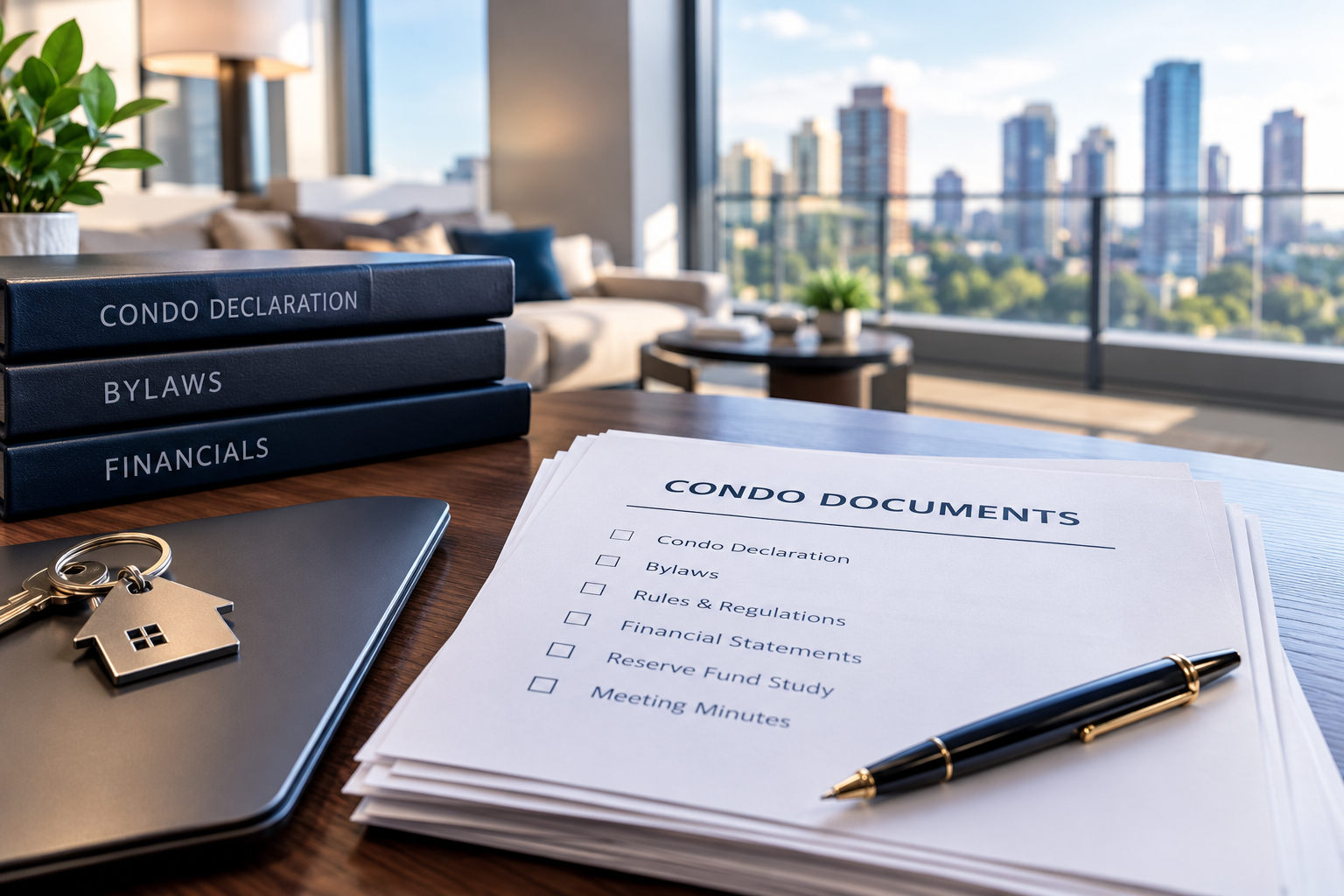
DocumentWhat It Tells YouWhat To Look For
Estoppel certificateCurrent condo fees, how they're paid, any amounts owingUnpaid fees, interest, or levies against the unit
Reserve fund study, plan & annual reportWhat major repairs are coming and how they're fundedStudy date, fund balance vs. recommended level, planned increases or levies
Financial statements & budgetWhether the building lives within its meansOperating deficits, fees in arrears, borrowing, sudden insurance/utility spikes
Board & AGM minutesWhat the board is actually dealing withRecurring leaks, parkade/roof issues, levy discussions, disputes, claims
Bylaws & rulesHow you're allowed to use your unitPet limits, rental/short-term rental rules, age restrictions, renovation approvals, parking
Insurance certificateCoverage and deductible sizeHigh water-damage deductible, recent claims, coverage gaps
Condominium planExactly what you ownWhether parking and storage are titled, assigned, or leased
Legal actions & written demandsLawsuits or claims against the corporationAny lawsuit, judgment, or demand over $5,000
Structural/building reportsKnown deficienciesEngineering reports, structural statements, post-tension cable details
Management agreementWho runs the building and howFrequent management turnover, or a thin self-managed board

The Reserve Fund Study Is the Document That Predicts Your Future Costs

The reserve fund is the building's savings account for major repairs and replacements — roofs, windows, elevators, boilers, parkades. Alberta requires a qualified person to conduct a reserve fund study at least every five years.

Three questions to run through when reading it:

  1. How old is the study? A study sitting at four or five years old may be working from stale repair costs.

  2. Is the fund keeping pace? Compare the current balance against what the study says should be there by now. A wide gap gets closed one way or another — usually through fee increases or a levy.

  3. What's scheduled in the next five years? A roof or parkade membrane due soon with insufficient savings is the clearest warning sign available.

A well-run building isn't one with no upcoming repairs — it's one that knows exactly what's coming and has been saving accordingly.

Special Levies: Who's Actually on the Hook?

A special levy (sometimes called a special assessment) is an extra charge owners face when the reserve fund can't cover a cost. The corporation generally bills whoever owns the unit at the time the levy comes due — which makes timing a real negotiating point.

If the minutes show a levy already approved or actively being discussed, you can ask the seller to cover it, hold back funds at closing, or adjust the purchase price accordingly. Your lawyer handles the legal mechanics — your job is knowing about it before you remove conditions, which is exactly why the minutes matter as much as the financials.

Insurance: The Deductible Is the Detail Buyers Miss

The corporation insures the building; you insure your own unit and contents. Since 2020, Alberta rules let a condominium corporation recover its insurance deductible — up to $50,000 — from an owner when damage originates in that owner's unit.

In plain terms: if your dishwasher hose fails and floods three floors below, the building's deductible can become your personal bill. Check the deductible figure on the insurance certificate, then confirm your own condo policy actually covers that amount — a quick call to your insurance broker settles this.

Bylaws That Change How You Actually Live There

Read the bylaws specifically for anything that conflicts with your plans:

  • Pets — number, size, and type limits, and whether board approval is required

  • Rentals — whether renting out the unit is allowed, and whether short-term rentals are permitted (relevant if you're buying as an investment property)

  • Age restrictions — some buildings restrict residency to older adults; see our guide to downsizing and retirement living if that's the direction you're headed, and check carefully if it isn't

  • Renovations — what needs board approval, including flooring changes in noise-sensitive buildings

  • Parking & storage — guest parking rules, vehicle restrictions, and what's allowed on a balcony

Bareland Condos and Townhouses Work Differently

Many townhouses and some detached homes are structured as bareland condos — your unit is the land parcel itself, and you own the building sitting on it. Fees tend to run lower since the corporation maintains less, often just roads, landscaping, and snow removal.

For these, confirm exactly what the corporation maintains versus what falls to you — roof and siding responsibility often lands on the owner. A bareland condo also needs its own Real Property Report, the same as a detached house.

Buying New From a Developer

New condos come with an entirely different document set — the purchase agreement, proposed bylaws, the condominium plan, and any management or recreational agreements. Alberta gives buyers of new units a cooling-off right: you can cancel within 10 days of signing unless the developer provided the required documents at least 10 days before you signed. A lawyer should confirm exactly how this applies to your specific contract.

With a new building, there's no history of minutes or financials to review — so scrutinize the proposed budget closely instead. Fees set artificially low to help sales often climb noticeably after the first year or two.

Red Flags Worth Slowing Down For

  • Reserve fund study is more than five years old, or doesn't exist

  • Fund balance sits well below what the study recommends

  • Minutes reference a special levy, repeated leaks, or envelope problems

  • The corporation is in active litigation, or its deductible recently jumped

  • A significant share of owners are behind on fees

  • Documents are missing or slow to produce

  • Bylaws block something you specifically plan to do

One red flag alone isn't necessarily a dealbreaker — it's a signal to ask more questions and price the risk into your offer.

Who Should Actually Review These?

Read them yourself first, since only you know what matters for how you plan to live there. For the financial and legal layer, bring in help:

  • Your realtor — knows which buildings have a track record of issues and what's typical for the area

  • A condo document review service — reads the full package and provides a written summary, usually for a few hundred dollars

  • Your real estate lawyer — reviews the legal points before closing

Document review doesn't replace a home inspection — the inspector covers your unit, the documents cover everything else in the building.

FAQ

What condo documents should I review before buying in Alberta? At minimum: the estoppel certificate, reserve fund study/plan/annual report, financial statements and budget, meeting minutes, bylaws, insurance certificate, and the condominium plan. Ask specifically about lawsuits and structural reports too.

How long does it take to get condo documents in Alberta? The corporation must provide requested documents within 10 days of a written request; the insurance policy can take up to 30 days. Many sellers have the package ready before listing.

What is an estoppel certificate? A signed statement from the condominium corporation confirming the unit's current fees, how they're paid, and any amounts owing or interest accrued.

How often is a reserve fund study required in Alberta? At least every five years, conducted by a qualified person.

Who pays a special levy when a condo sells? Generally the owner at the time the levy is due. If one's approved or anticipated, buyers can negotiate for the seller to cover it or adjust the price.

Should I pay someone to review condo documents for me? For most buyers, yes — a professional review typically costs a few hundred dollars and can flag issues worth far more than that.

Start With the Right Building

Good condo buildings aren't hard to find in Edmonton — the documents are how you tell them apart from the ones to avoid. When you're ready to look, browse Edmonton condos or Downtown Edmonton, get pre-approved, and reach out about any specific building you're considering — we'll tell you what we already know about it before you write an offer.

This reflects Alberta Condominium Property Act requirements current as of the original publication — confirm current rules with a real estate lawyer before relying on them.


Haupt Phaneuf Real Estate Team | eXp Realty Canada 📍 271 Heath Rd NW, Edmonton, AB T6R 1V3 📞 (780) 993-8574

Read

New property listed in Zone 06, Edmonton

I have listed a new property at 12020 63 Street NW in Edmonton. See details here

PRIME MULTI-FAMILY DEVELOPMENT OPPORTUNITY! Exceptional 8,105 sq. ft. (753 m² / 0.19 acre) double lot offering approximately 66 ft of frontage x 123 ft of depth. An outstanding opportunity for builders, investors and developers looking for a substantial infill site with strong redevelopment potential. The property may be well suited for a multi-family development utilizing the MLI Select program, subject to approvals and program requirements. The existing single-family home is livable and in good condition, offering the ability to hold or generate income while future development plans are pursued. A rare opportunity to secure a large, versatile development parcel with an existing residence in place.

Read
Data last updated on October 2, 2026 at 09:30 PM (UTC).
Copyright 2026 by the REALTORS® Association of Edmonton. All Rights Reserved.
Data is deemed reliable but is not guaranteed accurate by the REALTORS® Association of Edmonton.
The trademarks REALTOR®, REALTORS® and the REALTOR® logo are controlled by The Canadian Real Estate Association (CREA) and identify real estate professionals who are members of CREA. The trademarks MLS®, Multiple Listing Service® and the associated logos are owned by CREA and identify the quality of services provided by real estate professionals who are members of CREA.